Showing posts with label ventricular septal defect. Show all posts

Monday, September 20, 2010

When bad news hits twice

Around this time last week, we discovered that our 2-year-old daughter had an undiagnosed PDA (Patent Ductus Arteriosus). Not a particularly alarming congenital heart defect, but after losing our son in June to TOF (Tetralogy of Fallot), I was beside myself with worry and concern for Sadie.

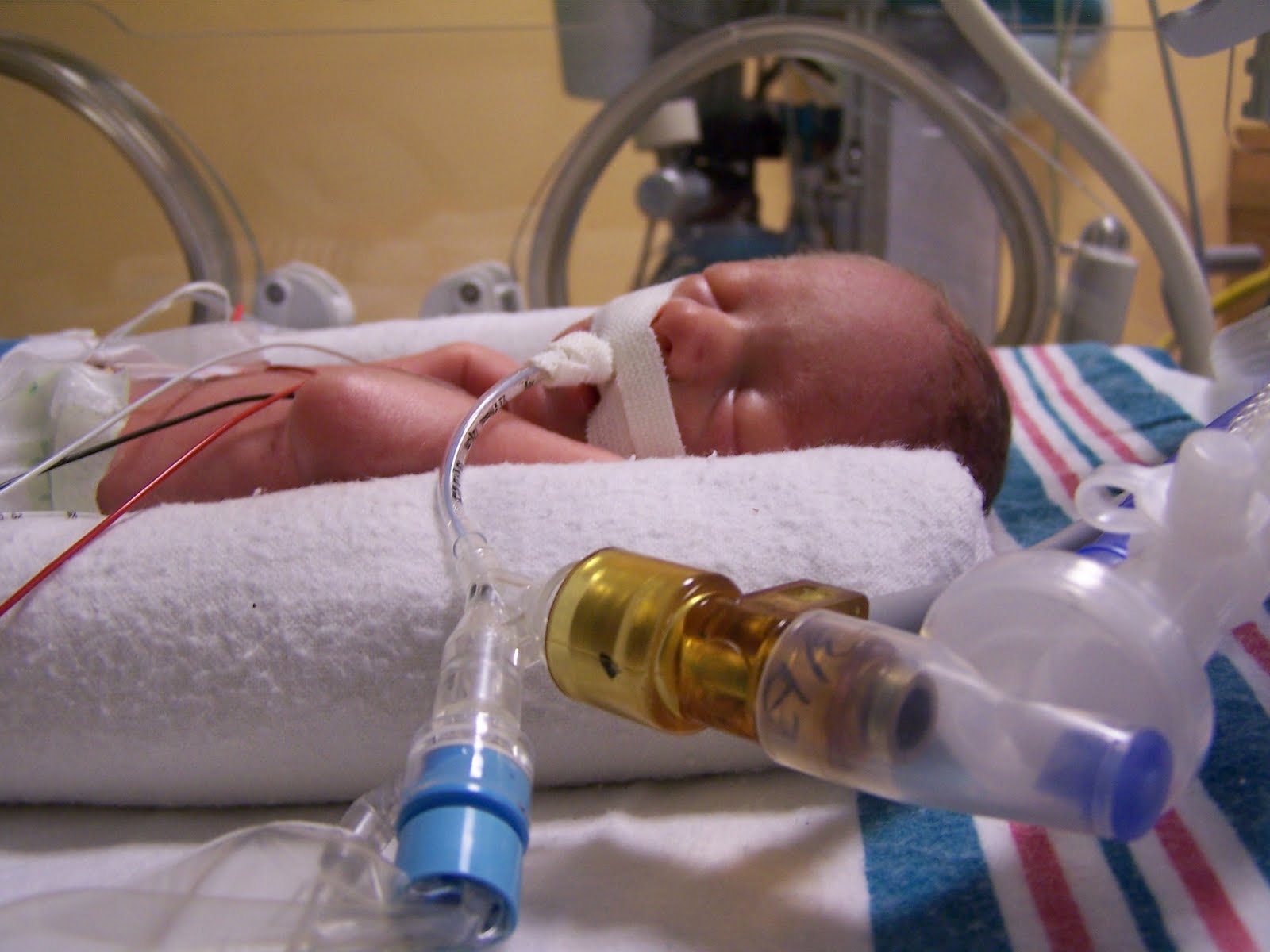
Sawyer in the NICU

When we revisited Comer Children's Hospital to meet with Sawyer's neonatologist after he passed away, one thing she said to me had stuck out among all the medical terms and tears. She suggested that it wouldn't be a bad idea to get Sadie's heart checked out, as congenital heart defects tend to group themselves in families.

Shortly after Sadie's birth, she began to have her share of troubles too. In the NICU for a few weeks and on a ventilator - she fought very hard and made huge strides every day. But,one thing I never thought twice about was her heart. We were told she had a murmur and that most babies outgrow them and that they are most often "innocent."

Sadie in the NICU

When the cardiologist began listening to her heart last week, I was taken by surprise when she mentioned the murmur again. Her pediatrician hadn't said one word about it at any visit we've had in over two years.

As the appointment continued, Sadie had an EKG and finally, an echocardiogram.

Sadie was a trooper and was sitting in her pull-up on the exam table, coloring while the cardiologist informed me that she indeed had a PDA and narrowing of her pulmonary artery (Pulmonary Stenosis). Thankfully, her PDA doesn't need to be repaired surgically at this juncture in her life. She will continue to be monitored each year for changes and eventually it will be repaired.

I never would have thought twice about Sadie's heart if it wasn't for the suggestion from Sawyer's doctor.

According to the American Heart Association, "the risk of having a child with congenital heart disease is higher if a parent or a sibling has a congenital heart defect."

Most parents of heart babies struggle to come to terms with the often scary diagnosis of their infant or small child. And often, other siblings can be overlooked in the craziness that is the life of a CHD family. As mothers and fathers, we have instinct for a reason and I've talked with so many parents who question whether or not their other children should be seen by a cardiologist. No one wants to hear bad news twice, but we also want to do what is the best for our little ones.

In sharing our story, I hope this helps one family that may be struggling to make that difficult choice an easy one.

Tuesday, July 20, 2010

Sawyer's Heart


Today we met with Sawyer's neonatologist to get a better understanding on his short life and the heart defect that took our baby too soon.

A healthy heart has four chambers. Between two of those four chambers, the left and right ventricles, there is a wall that separates the blood. In Sawyer's heart there was a "large subaortic anteriorly malaligned VSD" - simply put - a large hole where there was supposed to be a wall.

The American Heart Association defines a VSD as "A ventricular septal defect (VSD) is a defect in the septum between the right and left ventricle. The septum is a wall that separates the heart’s left and right sides. Septal defects are sometimes called a “hole” in the heart. It’s the most common congenital heart defect in the newborn."

Sawyer's VSD, the doctor explained, was large (between 5.6 to 6.0 mm).

Healthy hearts also have two main arteries that take blood to different parts of the body. The aorta, which takes oxygen-rich blood to all parts of the body - and the pulmonary valve (which branches into two arteries), which carries oxygen-poor blood to the lungs to become oxygenated.

The doctor went on to explain that Sawyer had "Pulmonary Atresia" - sadly, this meant that his pulmonary artery/valve was completely missing.

The American Heart Association defines Pulmonary Atresia as "a congenital malformation of the pulmonary valve in which the valve orifice fails to develop. The valve is completely closed thereby obstructing the outflow of blood from the heart to the lungs."

To make up for this catostrophic defect, Sawyer's heart formed several small "MAPCA's" which are small arteries that develop to supply blood to the lungs when pulmonary circulation is underdeveloped (Pulmonary Atresia in Sawyer's case).

His official diagnosis was "Tetrology of Fallot (Pulmonary Atresia) Truncus Type IV". Again, here is a better definition to help you understand the severity of Sawyer's heart defects.

"Tetralogy of Fallot with pulmonary atresia is a severe variant in which there is complete obstruction (atresia) of the right ventricular outflow tract, causing an absence of the pulmonary trunk during embryonic development. In these individuals, blood shunts completely from the right ventricle to the left where it is pumped only through the aorta. The lungs are perfused via extensive collaterals from the systemic arteries, and sometimes also via the ductus arteriosus."

All of this put together, meant that Sawyer's little heart - as hard as it was working and even with the maximum amount of help that the doctors and nurses could give him - would never function well enough to survive. If he had been full-term, there may have been surgical options for him, but this would have been if he could ever have gotten stable enough to handle open-heart surgery - to which the neonatologist explained "the outcome may have not been much different."

Sawyer was a very sick baby. With his prematurity and heart condition combined, there weren't any options for our son.

Over the past few weeks, I have felt immense guilt over the choice that we made to take Sawyer off of life support. Today, his doctor explained to us that it was only a matter of time before his body gave out. They were doing everything possible to keep him stable, and even then - his stats continued to drop rapidly.

The doctor told us something today that I will never forget as a mother. She said "There was only so much we could do and what he really needed was you."

And that was it. Erik and I quietly cried as the realization of what happened to our baby boy was finally understood.

No parent should ever have to sit there and hear the things we were told today. It was painful and heartwrenching to fully understand and comprehend just how serious and fatal his congenital heart defect was.

Our journey is just beginning. And as we begin this walk down a new road in our lives, our hope is to honor Sawyer's memory by working to fund research on all congenital heart defects and premature birth.

Again, thank you all for the continued love, prayers and support. We need them now more than ever.

Love - Erik, Michelle and Sadie Williams